


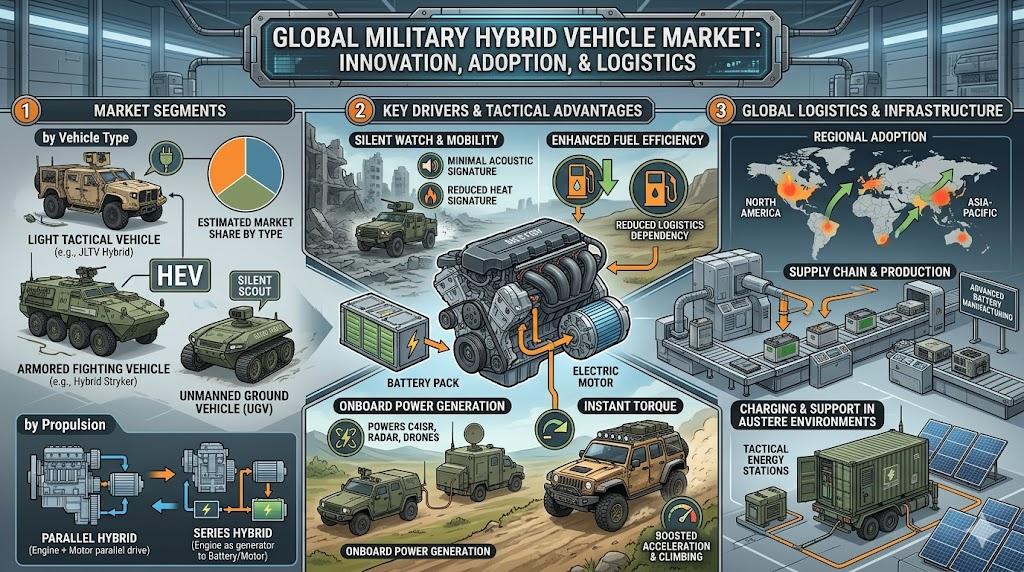
The global defense sector is currently witnessing a transformative shift toward electrification as nations seek to balance tactical superiority with energy efficiency. The Military Hybrid Vehicle Market is anticipated to expand at a CAGR of 14.5% from 2026 to 2034. This rapid growth is fueled by the transition from traditional combustion engines to sophisticated hybrid electric drive systems that offer silent operation and enhanced power for modern battlefield electronics.
Emerging Trends in Hybrid Defense Technology
A prominent trend shaping the industry is the development of "Silent Watch" and "Silent Mobility" capabilities. Unlike traditional diesel engines that generate significant heat and noise, hybrid systems allow vehicles to operate on battery power alone for tactical maneuvers. This reduces the thermal and acoustic signatures of the vehicle, making it nearly invisible to infrared sensors and acoustic detection equipment. Additionally, the integration of regenerative braking technology is becoming a standard feature, allowing vehicles to recover energy during deceleration and store it for later use, thereby extending the operational range without increasing fuel load.
Download Sample PDF:https://www.theinsightpartners.com/sample/TIPRE00017702
Expanding Power Requirements for Combat
Modern warfare relies heavily on high power electronic suites, including jammer systems, advanced radar, and directed energy weapons. Traditional alternators often fall short of meeting these massive energy demands. A major trend in the market is the shift toward using hybrid vehicles as mobile microgrids. These vehicles are designed to export significant amounts of electrical power to support command centers or field hospitals. This dual purpose functionality makes hybrid platforms indispensable for remote operations where traditional power infrastructure is non existent.
North America Military Hybrid Vehicle Market Insights
The North America Military Hybrid Vehicle Market is currently the most significant regional sector, driven largely by the aggressive modernization programs of the United States Department of Defense. The U.S. Army and Marine Corps are actively investing in hybrid electric drive (HED) prototypes for both wheeled and tracked platforms to reduce the logistical "tether" of fuel convoys. By integrating hybrid technology into existing fleets like the Bradley Fighting Vehicle or exploring it for the Next Generation Combat Vehicle (NGCV) program, North America remains at the forefront of innovation. The focus here is on achieving a balance between reduced fuel consumption and the high torque requirements necessary for heavy armored maneuvers.
Advancements in Battery and Powertrain Architecture
The industry is seeing a move toward modular powertrain architectures. This allows defense forces to swap or upgrade battery packs and power electronics as technology improves without needing to redesign the entire vehicle chassis. Manufacturers are focusing on high energy density lithium ion batteries that are ruggedized to withstand the extreme vibrations and ballistic threats associated with combat environments. The shift from series hybrid to parallel hybrid configurations is also a key technical trend, providing flexibility in how power is delivered to the wheels or tracks based on the specific mission profile.
Key Players in the Military Hybrid Vehicle Market
The market is characterized by collaboration between traditional defense contractors and specialized propulsion technology firms. Key industry participants include:
-
BAE Systems
-
General Dynamics Corporation
-
Oshkosh Defense
-
Leonardo S.p.A.
-
Rheinmetall AG
-
Textron Inc.
-
RTX (Raytheon Technologies)
-
Allison Transmission
-
Northrop Grumman
Logistical and Operational Benefits
Beyond the battlefield, the move toward hybrid systems offers massive logistical advantages. Reducing fuel consumption by even a small percentage can lead to significantly fewer fuel tankers on the road, which are often targets for insurgent attacks in conflict zones. Hybrid vehicles also require less frequent maintenance for braking systems due to regenerative systems and offer improved acceleration, which is critical for evasive maneuvers. These operational efficiencies are driving global procurement agencies to prioritize hybrid options in their long term acquisition strategies.
Future Outlook
As the market moves toward 2034, the convergence of autonomous technology and hybrid propulsion will likely define the next generation of military hardware. The military hybrid vehicle market is set to benefit from the broader commercial automotive shift toward EVs, leveraging advancements in power electronics and weight reduction. With the projected 14.5% CAGR, the industry is transitioning from experimental prototypes to standard issue equipment. This evolution will ensure that future armed forces are more lethal, more stealthy, and significantly more energy independent on the modern battlefield.
Related Reports:
Space Sensors and Actuators Market
About Us
The Insight Partners is a leading global market research and consulting firm specializing in delivering actionable insights across various industries. Our research reports combine extensive primary and secondary research to provide accurate market intelligence, helping businesses make informed strategic decisions. The company provides detailed analysis on emerging technologies, market trends, competitive landscapes, and growth opportunities across sectors including technology, healthcare, manufacturing, and energy.
Contact Us
The Insight Partners
Phone: +1-646-491-9876
Email: sales@theinsightpartners.com
Website: https://www.theinsightpartners.com

 English
 Arabic
 French
 Spanish
 Portuguese
 Deutsch
 Turkish
 Dutch
Dutch
 Italiano
 Russian
 Romaian
 Portuguese (Brazil)