


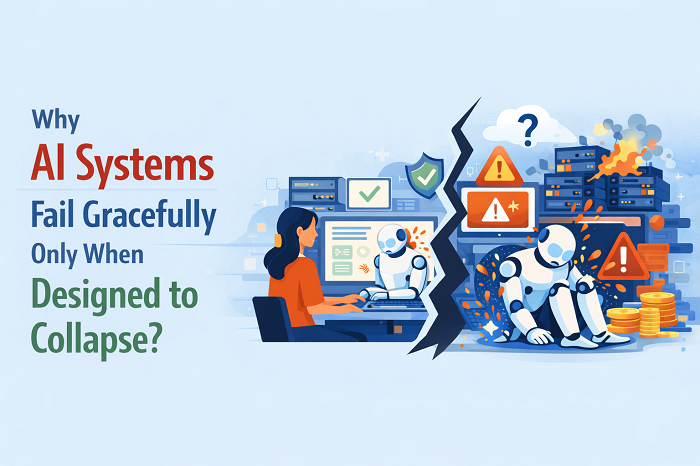
AI systems are often marketed as intelligent, adaptive, and self-improving. But no AI system is immune to failure.
Unlike traditional software, AI-driven platforms don’t just crash—they can degrade silently, hallucinate outputs, drift from expected behavior, or produce confident but incorrect results.
In fast-growing innovation hubs like Orlando, companies investing in mobile app development Orlando are integrating AI-powered features at scale. The harsh reality? AI systems fail gracefully only when engineers intentionally design them to collapse safely.
Graceful failure is not automatic—it is engineered.
What Does “Fail Gracefully” Actually Mean?
Failing gracefully does not mean avoiding failure. It means:
-
Containing damage
-
Preserving user trust
-
Protecting data integrity
-
Maintaining core functionality
-
Recovering predictably
In deterministic systems, failure often results in visible crashes. In AI systems, failure may appear as:
-
Subtle inaccuracies
-
Decreased recommendation relevance
-
Biased outputs
-
Misinterpretation of user intent
-
Gradual performance degradation
Without collapse planning, these failures compound.
Why AI Systems Behave Differently Under Stress
AI models operate in probability spaces. They generate outputs based on statistical likelihood, not fixed logic.
Under stress conditions such as:
-
Unfamiliar inputs
-
Out-of-distribution data
-
High latency environments
-
API overload
-
Model drift
AI systems don’t simply stop. They often continue producing lower-quality outputs.
This makes silent failure more dangerous than visible system crashes.
Designing Systems That Collapse Safely
To fail gracefully, AI systems require intentional safeguards, such as:
-
Confidence threshold triggers
-
Deterministic fallback logic
-
Human-in-the-loop review
-
Circuit breaker patterns
-
Rate limiting and throttling
-
Observability and alerting systems
When an AI model’s confidence drops below a predefined threshold, the system should revert to deterministic logic or simplified workflows.
Graceful collapse means reducing capability without compromising integrity.
The Importance of Confidence Thresholds
Probabilistic systems output confidence scores. Engineers must define acceptable reliability boundaries.
For example:
-
If prediction confidence is below 80%, trigger fallback
-
If anomaly detection crosses threshold, isolate system
-
If inference latency spikes, switch to cached responses
Without thresholds, systems continue operating even when accuracy deteriorates.
Collapse triggers are intentional safety valves.
Fallback Architectures in Mobile Applications
In mobile app development Orlando projects, AI-powered features must not compromise core user experience.
Consider common mobile scenarios:
-
AI chatbot misinterprets user query
-
Recommendation engine produces irrelevant content
-
Voice recognition fails to parse input
-
Predictive search returns inconsistent results
A well-designed mobile app will:
-
Offer alternative navigation paths
-
Provide manual override options
-
Deliver cached content
-
Notify users transparently
Graceful collapse preserves usability even when intelligence temporarily degrades.
Monitoring: Detecting Failure Before Users Do
AI systems require continuous monitoring beyond uptime metrics.
Engineers must track:
-
Model accuracy trends
-
Drift in prediction distributions
-
Bias indicators
-
Latency patterns
-
API usage anomalies
Failure in AI systems is often gradual. Observability ensures intervention before damage spreads.
Monitoring systems act as early warning mechanisms.
Why Deterministic Safety Nets Still Matter
AI does not eliminate the need for deterministic systems—it increases it.
Hybrid architectures combine:
-
AI-driven decision layers
-
Rule-based safety controls
-
Manual override capabilities
-
Structured validation mechanisms
In mobile app development Orlando ecosystems, deterministic safeguards ensure that AI enhancement never undermines reliability.
AI can innovate. Deterministic systems protect.
Cost and Scalability During Collapse
AI inference services often operate under usage-based pricing models. When systems are stressed, costs can spike unexpectedly.
Intentional collapse mechanisms can:
-
Throttle excessive requests
-
Shift to lighter-weight models
-
Cache previous results
-
Disable non-essential AI features temporarily
This protects both system stability and operational budgets.
Scalability must include failure containment planning.
The Cultural Shift: Engineering for Failure
Traditional engineering often aims to prevent failure at all costs.
Modern AI engineering recognizes:
Failure is inevitable.
Uncertainty is constant.
Performance fluctuates.
The goal is not perfection—it is resilience.
Engineering teams must proactively simulate failure scenarios:
-
Inject anomalous inputs
-
Stress-test inference pipelines
-
Test fallback triggers
-
Audit confidence threshold behavior
Systems that are never stress-tested are not resilient.
Ethical Considerations in Graceful Failure
AI failures can impact:
-
User trust
-
Data privacy
-
Decision fairness
-
Brand reputation
Designing for graceful collapse ensures:
-
Biased outputs are contained
-
Inaccurate predictions are isolated
-
Sensitive data remains protected
Ethical resilience is as important as technical resilience.
The Future of AI System Resilience
As AI adoption grows, resilience engineering will become a strategic differentiator.
Future AI systems will likely include:
-
Self-diagnosing architectures
-
Adaptive fallback routing
-
Real-time confidence auditing
-
Automated retraining triggers
But even advanced automation requires human-defined safety boundaries.
Graceful collapse will remain an intentional design decision.
Conclusion: Failure Is Not the Enemy—Uncontrolled Failure Is
AI systems fail gracefully only when they are designed to collapse safely.
Without intentional thresholds, fallback logic, and monitoring frameworks, AI failures can become silent, unpredictable, and damaging.
For organizations investing in mobile app development Orlando, resilience must be embedded at the architectural level—not added after deployment.
The strongest AI systems are not those that never fail.
They are the ones that fail intelligently, transparently, and safely.

 English
 Arabic
 French
 Spanish
 Portuguese
 Turkish
 Dutch
Dutch
 Italiano
 Russian
 Romaian
 Portuguese (Brazil)
 Tiếng Việt